


Electric vehicles are a rising force in the auto industry and Tesla leads them all in innovation, production, and sales. Like any new product that enters the market, it raises many questions.
One of the questions I get asked repeatedly is, are Tesla cars easy to steal? Well, the answer is that it is very difficult to steal a Tesla, let alone benefit from that said theft. Not to say it is not impossible thanks to SARA (Signal Amplification Relay Attack ). For the most part, however, Tesla is not easy to steal for the following reasons:
- Tesla cars are fully controlled by their computer software. There is no ignition or starter switch that one could simply start the vehicle with.
- To steal a Tesla the thief needs access to the key fob, the car owner’s valet card, phone, or the PIN the car owner chose to start the car with. Either that or the car can simply be physically towed.
- Tesla cars are monitored 24/7– so even if the car has been stolen it can be tracked down very easily.
Now that we have established the main reasons Tesla cars are less prone to theft than other cars, let’s dive into the details while finding out how to protect one’s car against some very savvy thieves.
Tesla Cars a Fully Computerized
Tesla, like other electric cars, is a fully computerized car. This means that all the movement of the car relies on the software that stands behind it.
Even if a thief somehow manages to unlock the vehicle and get into the driver’s seat (without using the owner’s key fob), it’s not like they can drive off into the sunset with your new Tesla. Without having electronic access to drive the car he will find himself sitting in the car with very little to do. After all, there is no ignition or starter switch that one could simply hotwire the car with like you’re used to seeing in action movies.
The thief’s other option is to physically tow the car. The problem with this scenario is that once the car owner notices the car is gone, the car can still be located using remote tracking by an app, contacting the police, or the company’s customer service. The only way to make the vehicle disappear completely is to drag it to a place where it cannot be located (a location without an internet connection) and this is not a very easy task these days.
To Steal a Tesla a Thief Needs Access

This brings me to the next point. To steal a Tesla (not by towing) the thief needs access to the vehicle owner’s key fob, the car owner’s valet card, phone, or the PIN the car owner chose to start the car with. The thief would likely have to pickpocket the driver. A relatively common action among thieves. Of course, even if your phone is stolen the thief still needs either your face, your password, or your fingerprint to hack it. In this scenario, however, the owner of the vehicle needs to be near the car for it to work.
When it comes to a parked car in the middle of the street, it’s more complicated. If it is parked in your home garage – and the keys are in another room in the house, the thief can use a new system called SARA (Signal Amplification Relay Attack) which extends the distance between the key fob and the car and copies the electronic code so that the driver can steal the vehicle in a matter of seconds even if he does not physically have the key fob. If it happens in the middle of the night, the thief would have enough time to gain distance before the owner of the car notices the disappearance. Still – and here I am already moving on to the next section – in almost one hundred percent of the cases it will be possible to locate the vehicle.
If, however, the aforementioned scenario puts you off there is something you can do about it, and it’s rather quick and cheap:).
Put Your Key Fob in a Faraday Pouch
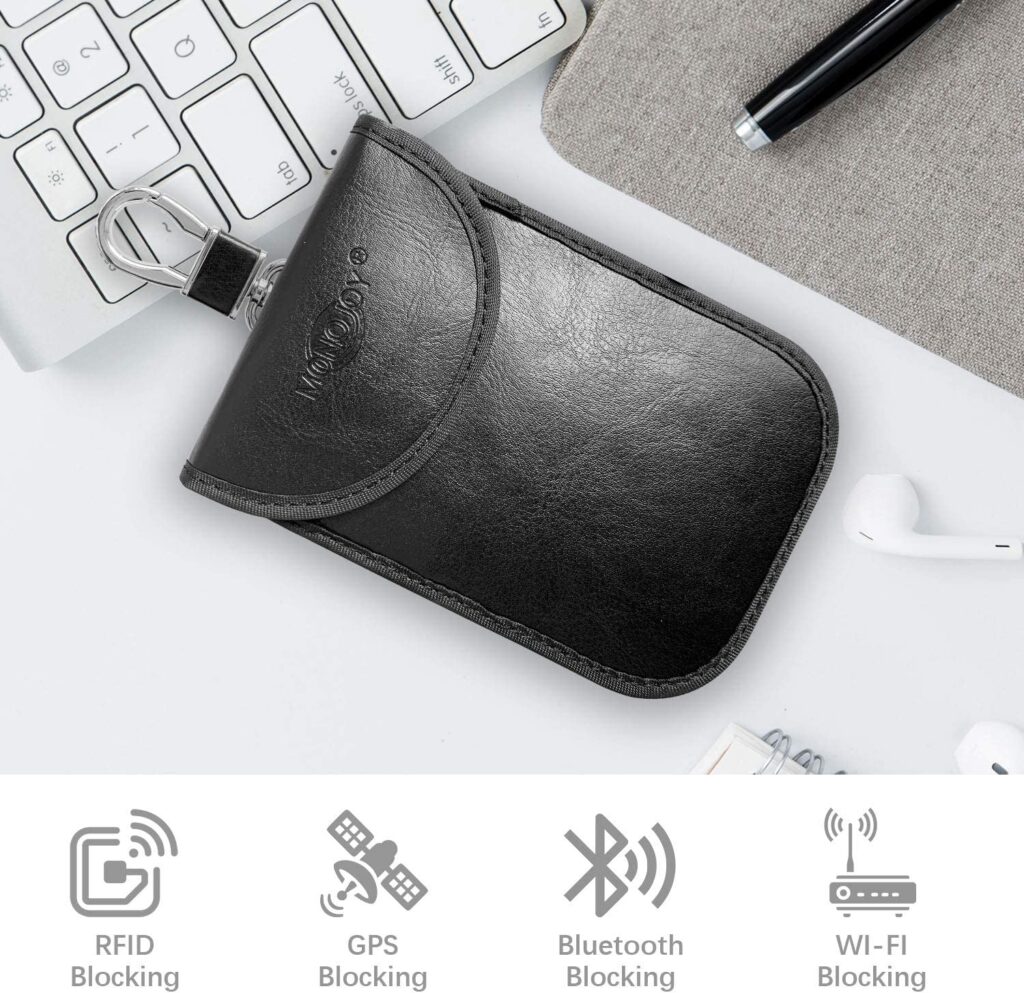
If you store your key fob in a Faraday pouch, it will block all wireless signals from transmitting therefore not giving the thief access to the car. This pouch gives you a complete signal blocker for your vehicle key fob. It prevents thieves from picking up and relaying signals from your key, and shields against break-ins and keyless ignition theft.
Tesla Cars Are Being Tracked 24/7
As I mentioned before, Tesla cars are fully computerized, online 24/7, and very much like any phone these days it can send the car locations to Tesla’s servers who then allow the owner of the car to know through a phone app. So, even if the car has been stolen it can easily be tracked down.
Both the owner and Tesla can pinpoint where the car is and both have remote access to the car.
There is a way around it though:
The thief can store the car in a Faraday cage while it’s being towed as well as later on while deciding what to do with it and until they block it from GPS and cellular networks for good. If we’re talking about old-generation Tesla then cellular signal jammer can jam with the GPS connection quite easily.
It’s Hard to Benefit from a Stolen Tesla
As with any crime (or any action we do, to be honest), the incentive to act is very important.
In the case of stealing a Tesla – the incentives are pretty low:
- Since the cars are computerized and connected to the internet, it is effortless to locate them and very difficult to get rid of them for profit.
- If to avoid detection, the thief disassembled the car from the internet for good (and caused all kinds of damages to the car because turning the components off won’t do) the result would be the car in possession would lack so many of the treats that identify it, greatly devaluing it.
- Tesla has a monopoly on parts and service – there are not many independent repair shops out there so it will be really hard to get rid of the valuable parts or service the stolen vehicle.
- Tesla’s market share and the nature of the customers (upper middle class) is such that Tesla’s parts are not in high demand and therefore of low value.
That being said, the motivation isn’t always connected to the car industry itself. For example, in countries where marijuana is illegal, there has been an increase in thefts of electric vehicles and hybrids recently. Thieves are not going after the car, but rather, targeting the battery. They use the battery for the electrical needs of growing marijuana in commercial quantities. Since the batteries operate autonomously and are not connected to the electricity grid, the authorities cannot monitor a suspicious increase in electricity consumption and thus the grower can remain under the radar and continue their activity which is still illegal in many countries around the world. I guess it’s true when they say “where there’s a will there’s a way…”
Tesla Security Features that Stand Out
A few years ago (2018) Tesla added some security features both in the key fob (it tightened the security and improved cryptography) and by allowing drivers to choose a password (PIN to Drive) feature that the drivers use by typing to start the car.
Taking Control of the Car from Afar
This is yet another scenario that many Tesla owners find themselves dreading, and while I’m not here to ignore their fear I will say this: hacking a Tesla remotely requires technical skills that I doubt the modern-day car thief has. It might be a reality in the future but we are still a long way from getting there, and I’m quite sure Tesla will find a way to fight back (like shutting it off remotely for instance ).
Conclusion
If you have read everything that has been written here, then you already understand that Tesla is relatively immune to random thefts and that the security loops like that can be breached by the SARA system have a solution: getting a Faraday pouch for your key fob, which is very cheap and accessible.
Of course, this does not mean that Tesla cars are completely immune to theft, but the technology that’s behind the car, as well as the low incentive for thieves, are the basis for its low theft rates.