

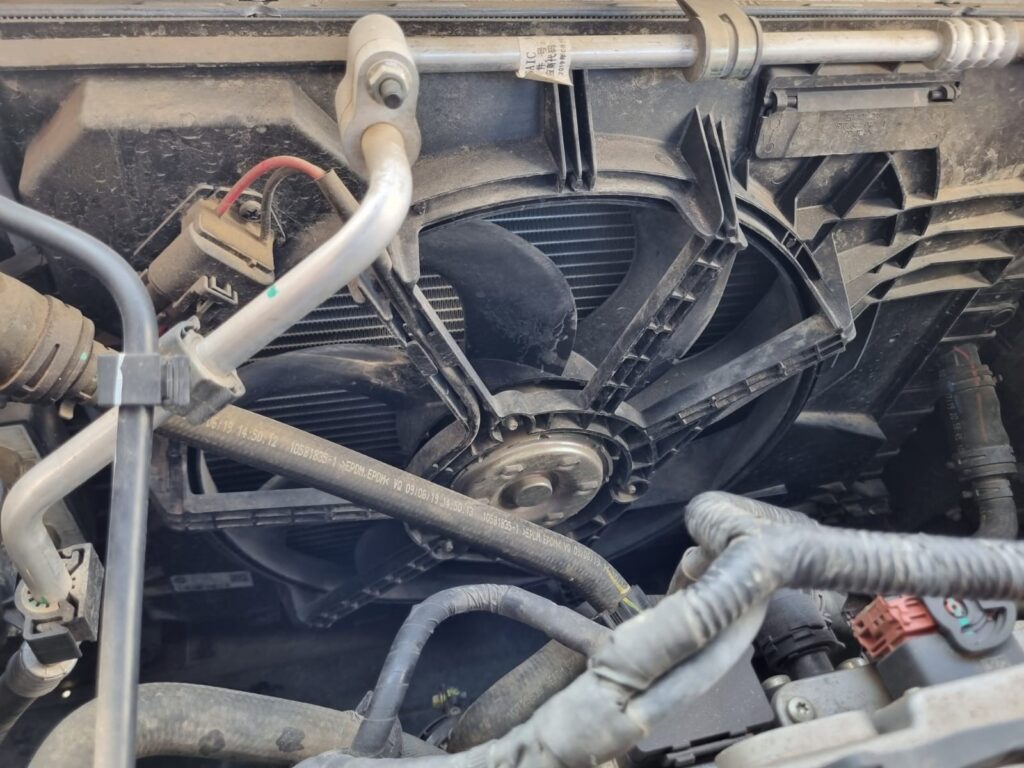
A lot of people notice that the electric vehicles of today don’t have a grill on the front of the car and so it raises the question “do electric cars have a radiator?” Do they even need one?
The simple answer is YES. Electric cars do have a radiator. The electric car has components such as batteries, power inverters, and motors that require cooling. The reason you do not see a grill on the front of electric cars is that electric cars are much more efficient than an internal combustion engine and therefore don’t need to remove as much heat. Because they need to get rid of less heat they do not need all that cooling power by air that traditional radiators need in internal combustion engine vehicles.
As I explained, electric vehicles do have a radiator, because, like gasoline-powered vehicles, they have components that heat up and require cooling. I’m referring to components like the battery, electric motor, inverter, and onboard charger.
However, these components produce less heat than those produced by their counterparts (or others) in a fuel-powered vehicle, therefore the amount of heat that needs to be disposed of is significantly smaller and there is less need for outside air to lower the temperatures (which is why there are no grills on most electric vehicles).
The cooling method in electric vehicles is not very different from the one you know from fuel-powered vehicles.
In electric vehicles, you will find a cooling system consisting of a coolant that goes through a pump and from there to a network of hoses and a radiator (yes they exist!) to release any excess heat into the air. Some electric vehicles use both cooling by air and liquid cooling combined to reduce the heat more effectively.
Please note that, unlike a fuel-driven car where the cooling system is designed to cool the entire vehicle, that is, the passenger compartment, ventilation, heating, and air conditioning combined, the electric cars cooling system is designed to cool the components only of the electric drivetrain.
As for the cooling systems, there are actually a couple of different methods designed to keep the EV cool. Will get into it shortly.
How Does the Fact That the Engine Runs on Electricity, Affect the Cooling System?
An engine of a fuel-powered car harnesses the fuel to mechanical energy compared to an electric vehicle engine that harnesses electrical energy to mechanical energy. With that difference in mind is easy to understand the benefits of an EV motor over an internal combustion engine (ICE) regardless of whether it’s using green energy, lower operating costs, and engine efficiency.
Motor efficiency is a key element. A regular car engine shows an efficiency of 30% on average compared to 90% or even more in an electric vehicle engine. All the rest is lost in heat and friction.
The importance of removing the heat produced by the engine, battery, and other components in an efficient manner should not be underestimated.
If the temperatures rise and the heat is not distributed properly, this can lead to various problems such as:
- Decreased efficiency
- Reduced component lifespan
- Decreased performance
By using a cooling system, EVs can effectively reduce heat and prevent these problems from occurring, ensuring that the vehicle performs at its best and has a long, reliable lifespan.
How do EVs cooling systems work?
As I mentioned earlier, there are a few methods regarding the cooling system in Ev’s. Let’s review how it works :
Cooling by a Liquid Loop
Undoubtedly the most efficient and also the more dominant method in electric vehicles today is the liquid loop. The efficiency comes from the fact that cooling by liquid allows greater control and more precision in the temperature of the battery and other components than provided by cooling by air.
The coolant absorbs the heat, cools the battery, and transfers the heat to a heat exchanger that gets rid of any heat.
The cooling system works in a simple way: the coolant (antifreeze) passes through a pump and from there continues through a system of pipes thus cooling the heat that is produced from the various components of the vehicle. The antifreeze helps to lower the freezing point of the mixture and increase its boiling point.
The heat produced by the components is transferred to the coolant which leads it to the radiator/ heat exchanger and from there to the outside air. This in turn cools the coolant and gets rid of the excess heat.
Once the coolant has passed through the heat exchanger the process starts all over again. The coolant returns to the pump and from there to the pipes and so on. This cycle continues as long as the EV is in on the move, helping to keep the temperature of the various components within acceptable limits.
Cooling by Air
Not all electric vehicles operate with a coolant cooling system, there are models that use an air cooling system.
In such a system, the heat is transferred from the heated components to be cooled by air through a system of pipes and fins.
How does It work?
The fins made (in most cases) of metal are attached to the tubes in a way that maximizes the surface area exposed to the air.
The air passes over the fins and then pipes absorb the heat coming from the various components in the car, cools them down, and then directs the excess heat outside the car.
In some electric vehicles, you can find, in addition to the existing mechanism, a fan that helps move the air through the pipes and fins thereby increasing the rate at which the heat is dissipated.
As I mentioned earlier, an air-cooled system may not be as effective at eliminating heat as a liquid-cooled system, particularly in high-performance EVs that generate large amounts of heat. However, air-cooled systems are simpler and more reliable than liquid-cooled systems, and they may be a good choice for EVs that do not generate a significant amount of heat.
A Combination: Cooling by a Liquid Loop and Cooling by Air
Why not use the best out of the two methods if you can? Indeed It is important to note that in some cases, EVs may use a combination of air and liquid cooling to reduce heat effectively. For example, an EV may use an air-cooled radiator to cool the electric motor and a liquid-cooled radiator to cool the inverter. This allows the EV to dissipate heat effectively and ensure that all of the components of the electric drivetrain are operating at their optimal temperatures.
A Refrigerants Cooling System
This method is likely the most familiar to us as it is used in AC systems, and there are in fact electric vehicles that are also cooled in this way to disperse heat.
How does It Work?
In a refrigerant-based system, the heat is transferred from the components being cooled to the air using a cycle of evaporation and condensation.
The cooling cycle begins when a refrigerant is vaporized in the evaporator. The evaporator is responsible for turning the cooling liquid into a gas through the evaporation process and is in contact with the car components that generate heat and need to be cooled, like the battery and engine. As the refrigerant vaporizes, it absorbs heat from those components, cooling them down.
The vaporized refrigerant is then compressed by a compressor, a device that converts power into kinetic energy by compressing air that can be released on command, which increases the temperature and pressure of the refrigerant. The compressed refrigerant is then passed through a condenser, when the gas reaches it, it condenses and returns to a liquid state. As the refrigerant passes through the condenser, it releases the excess heat into the air, cooling down in the process.
Once the refrigerant has been cooled in the condenser, it passes through an expansion valve and the result is low pressure and temperature of the refrigerant. From there on, the refrigerant goes into the evaporator and the whole process begins again.
Refrigerant-based systems are more complex and require more maintenance than other types of cooling systems, such as air-cooled systems.
The Reason Electric Cars Don’t Have a Grill
The fact that electric vehicles don’t have a typical radiator is exactly the reason why you won’t see a grill on the car, unlike an internal combustion engine car.
Because EVs do not have an internal combustion engine, they do not require a grill to provide air to flow into the engine compartment. Instead, EVs may have a number of other openings or vents at the front of the vehicle that allows air to flow through the vehicle and cool the components that generate heat.
In Conclusion
An internal combustion engine car and an electric car work in a similar yet different ways. Both vehicles need to cool different components in the vehicle regardless of whether it’s the engine or the battery and they have slightly different ways to achieve this goal. In both cases, the goal is to control the temperatures so that the critical components of the vehicle do not overheat and suffer unnecessary damage.
At the end of the day, even though an electric vehicle does not have a typical radiator, its cooling systems do a similar job to that of a radiator.